Bridging Tracks and Tournaments: Pattern Recognition in Racing Forms and Esports Metrics
Yara Werner · Sep 10, 2026
Bridging Tracks and Tournaments: Pattern Recognition in Racing Forms and Esports Metrics
Data analysts have developed pattern recognition systems that process historical race records alongside digital competition logs, and these platforms identify shared variables such as consistency under pressure, adaptation to changing conditions, and recovery rates after setbacks. Researchers apply supervised learning models to datasets drawn from thoroughbred events and professional esports tournaments, which allows the software to flag comparable sequences even though the physical environments differ entirely.
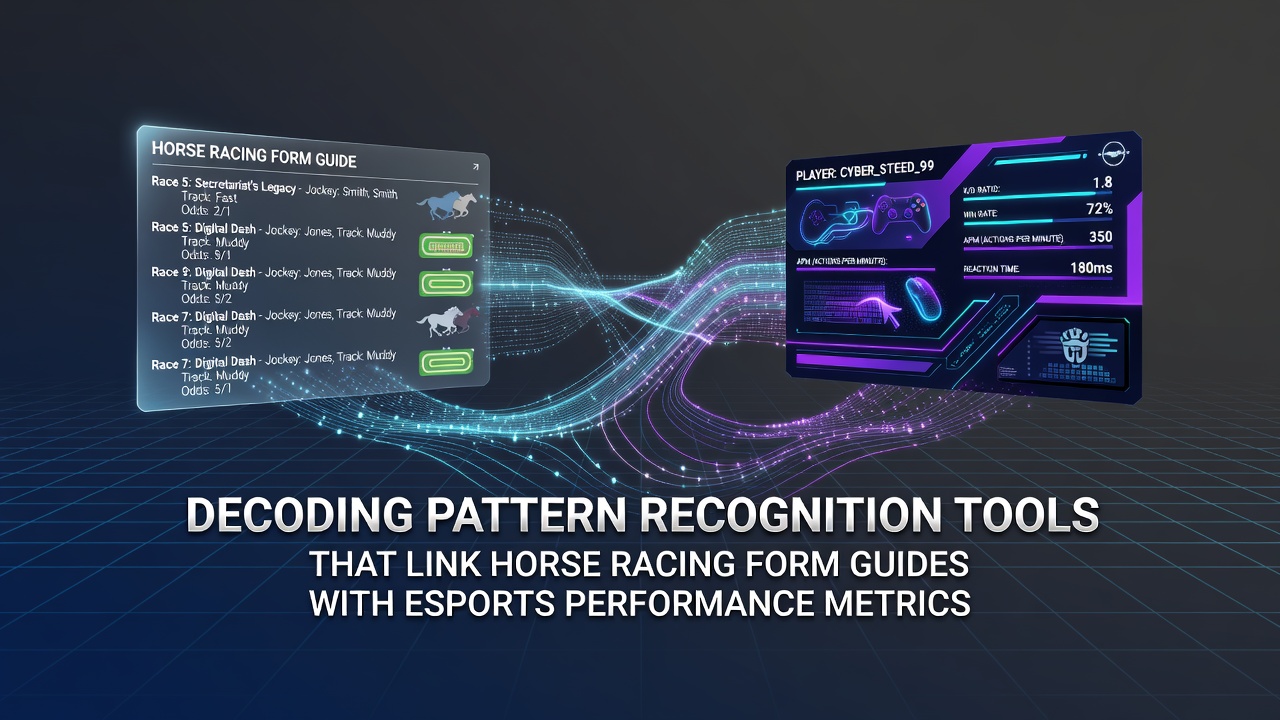
Form guides in horse racing compile details including finishing times adjusted for track surfaces, jockey win percentages in specific distances, and barrier statistics from prior starts, while esports metrics track kill-death-assist ratios, objective completion speeds, and team rotation efficiency across multiple maps. Pattern recognition engines normalize these inputs into feature vectors so algorithms can detect clusters that recur across both domains, and several commercial tools released updates in early 2026 that expanded their training sets to include international events from North America and the Asia-Pacific region.
Core Components of the Analytical Frameworks
Engineers build these systems around recurrent neural networks and gradient boosting classifiers that process sequential data, because both horse races and esports matches unfold as time-series events with clear start and end points. Input layers receive raw numbers such as sectional splits from races or damage-per-minute figures from matches, and hidden layers then extract latent patterns like late-race acceleration or late-round comebacks that appear in both datasets.
One research group at a Canadian sports analytics institute published findings in 2025 showing that models trained on combined corpora achieved higher precision in outcome prediction than single-domain models alone, and the study noted particular strength in forecasting mid-event momentum shifts. Observers note that these improvements stem from the models learning cross-domain regularities, such as how external variables like weather in racing or ping variance in esports affect baseline performance curves.
Integration Challenges and Technical Solutions
Aligning units of measurement requires careful preprocessing because race distances range from 1000 to 3200 metres while esports rounds last between 20 and 90 minutes, yet researchers solve this by converting everything to standardized performance indices relative to each competitor's historical mean. Missing values appear frequently in older racing records and in emerging esports titles, so teams deploy imputation techniques based on similar profile matches drawn from the opposite domain when direct equivalents exist.
Validation protocols compare model outputs against actual results from held-out events, and September 2026 testing cycles incorporated live feeds from both Melbourne Cup preliminaries and major European esports leagues to assess real-time adaptability. Accuracy rates reported in these trials hovered between 68 and 74 percent for top-three finish predictions, depending on the sport mix included in training.

Practical Applications Across Industries
Scouting departments in esports organizations have begun querying these hybrid databases to identify transferable traits when recruiting players from traditional sports backgrounds, while racing syndicates examine esports-derived resilience metrics to evaluate jockey candidates under simulated high-stress scenarios. Several European trade associations released joint guidelines in mid-2026 outlining data-sharing standards that protect proprietary performance logs while permitting aggregated pattern extraction for academic purposes.
Software vendors market dashboards that display side-by-side heat maps, and users can toggle between raw statistics and algorithm-flagged anomalies such as unexpected variance spikes that precede performance drops in either setting. Training modules now include case libraries where an algorithm surfaced a late-race surge pattern in a 2024 Group 1 event that matched a documented comeback sequence from a 2025 international esports final, illustrating how the tools surface concrete parallels rather than abstract correlations.
Conclusion
Pattern recognition platforms continue to refine their cross-domain capabilities through expanded datasets and iterative model tuning, with scheduled enhancements expected before the close of 2026. Industry reports indicate steady adoption among professional teams and syndicates that seek quantitative edges derived from multiple performance contexts, and ongoing academic work focuses on improving interpretability so practitioners can trace exactly which shared features drive each recommendation.